Saturday, September 05, 2015

Gaslighting of the Movement & Non-Violent Resistance in the Virtual World


In the days that followed the ceremony and the hanging of our "Black Lives Matter" sign, I waited each morning for the call to come: The sign has been stolen. The sign has been destroyed. The sign has been vandalized. This, because probably about half of the signs that have been hung, or posted at UU congregations, have been stolen, ruined, or painted over, by vandals.

But not just any vandals. Vandals with a specific, malicious purpose. Vandals with the energy and focus and the ill will and intent to get up early in the morning, park their car where it won't be noticed, and apply spray paint, all the while crouching and hiding along a busy road, to our nearly $400 double- sided sign.

To turn the words "Black Lives Matter" into "All Lives Matter."

So when I heard about the vandalism, a mere ten days after the ceremony to install our sign, I was sad but not surprised. I had been meeting with a man whose cancer had returned, and talking about deeper things. Talking about life, death, family, and love. His love for the world, and for another friend, whom he will eulogize next week.

Shortly after that meeting, I had to prepare to return to Kentucky to spend the Labor Day weekend with my family. Stopping along the way to field calls from TV, radio, and newspaper reporters about the damage, as well as congregational leaders about the decision to re-hang the sign when we realized it could not be repaired, it took me 5 hours longer than usual to travel home.

I had plenty of time to ruminate upon what had happened, what was happening, how I and the congregation had responded, would respond, and what it all meant.

The war on Black Lives Matter has had a two-pronged front, and neither have validity. One purports that the movement is "Anti-Police" and must be stopped. The danger here is not so much the ignorant and ill-informed citizens that believe it as it is the pundits, politicians, and media moguls who are perpetrating this notion. The reality is that a better-trained, more well-informed law enforcment and judicial system and citizenry will benefit our officers as well as criminals and unarmed citizens. the reality is that people want to shut down this dialogue because they fear facing the facts about over-policing, police brutality, and unwarranted killing of not only Black citizens, but citizens of all backgrounds. Because the facts are incredibly disturbing, and demand change. Because people fear and resist change.

The second prong of this attack is the idea that Black Lives Matter is "racist" because "All Lives Matter," and so somehow it is wrong to focus on only Black ones. The absurdity of this argument is so blatant that I don't even want to spend time on it. Somehow, I prefer the anti-police argument, because there I can see the line of reasoning, the fear that exists for officers of the peace, the difficult decisions they have to make, the anxiety their loved ones face, and I can extend my compassion to understand the defensive and angry reactions they or their families might have to "Black Lives Matter."

But these people, goaded on by the politicians and the commentators who irresponsibly feed their anger, are actually dangerous. We are heading into a time where the simple and legitimate request for the grievances of the Black (and yes, Brown) community to be addressed is at a crisis point, and what we are seeing is an attempt to stifle it, tamp it down, shut off all avenues of dialogue.

Unitarian Universalists aren't going to allow that. When the rubber hits the road, we will be there. I know this about my fellow people of the liberal faith. We are going to hold the line. We are the people of reason and we are the people of justice and courage.

So my own act of non-violent non-resistance right now, is to keep on preaching, keep on reaching, keep on speaking, keep on hanging up the sign, keep teaching, and not be delayed. deterred, distracted, depressed, demeaned, or detoured by these voices of hate and untruth.... be they on Facebook, with spray paint, in comments on the articles, or on the radio. I don't answer them, and for the most part, I don't read them.


Truth does have a way. The sign is back up.


Tuesday, September 01, 2015

TAKING IT TO THE STREETS


Over the past three weeks, I have had adequate time to reflect upon three words. Black. Lives. Matter. Since I am a "word person," an English major, a writer, a preacher, and a reader, words are my tools. They are my weapons at times, my children sometimes, and my companions. It is words that have opened my mind, and words that have helped me to be of service to others.

I think we knew that posting a sign that read Black Lives Matter  on the road in front of our church's property was a big decision. We prepared for months, explaining it to the congregation through various venues. I preached on it numerous times.


We had a ceremony on Sunday, August 23, to dedicate the sign. It was a beautiful day, and a beautiful ceremony. Singing. Holding hands. Tears.


Some things happened that day that I suspect will remain in my memory for the rest of my days. When I told the minister of the nearest AME congregation about our decision to post the sign, she said that she would come, and support us. As it turned out, those friends who came from St. Paul AME were not the only persons of color who showed up. We do have, now 4 families and individuals who are African American.. they were there, and brought family, and a Community Organizer from Atlantic City came, bringing a Black minister. Another minister we had met in our community work showed up too, just as the ceremony was ending.


But it was actually a few unplanned things that stand out for me: first, one of our members offered to sing. She sang, "A Change is Gonna Come," and that was how we opened the service. Her singing was radiant. It brought everyone into the shared space, hearts and minds. Then, I had asked our Board President, Art Wexler, to say a few words. Art is a recently retired administrator of a Community College. He is quiet and unassuming, but wise and direct. He started to speak, and then he said, "One more thing: Michael Brown's life.. mattered. Freddie Gray's life.. mattered. Eric Garner's life mattered." He mentioned a few others. But then he continued, "Emmett Till's life mattered. Medgar Evars' life mattered. These killings we have seen this year are abominations.." During his words, I heard the softly whispered chorus of "Yes," and "Amen," from the Black attendees. That's when tears filled my eyes. But it was not until hours later, driving home, that the full impact of what Art had dne with those few words hit me, and I shook with sobs. He had been, in a sense saying the Jewish prayer of mourning, the Kaddish, and raising the importance of these deaths (ehich until that moment hadn't been mentioned that day) to the same level as those historic, history-making ones. You see, Art grew up in a Jewish household, but he also attended an historically black college, so even though he is quiet, and reitiring, he has a wealth of thought, and just the right words. I can only begin to imagine how hearing those words from a white male in a position of power must have felt to our guests. Words.


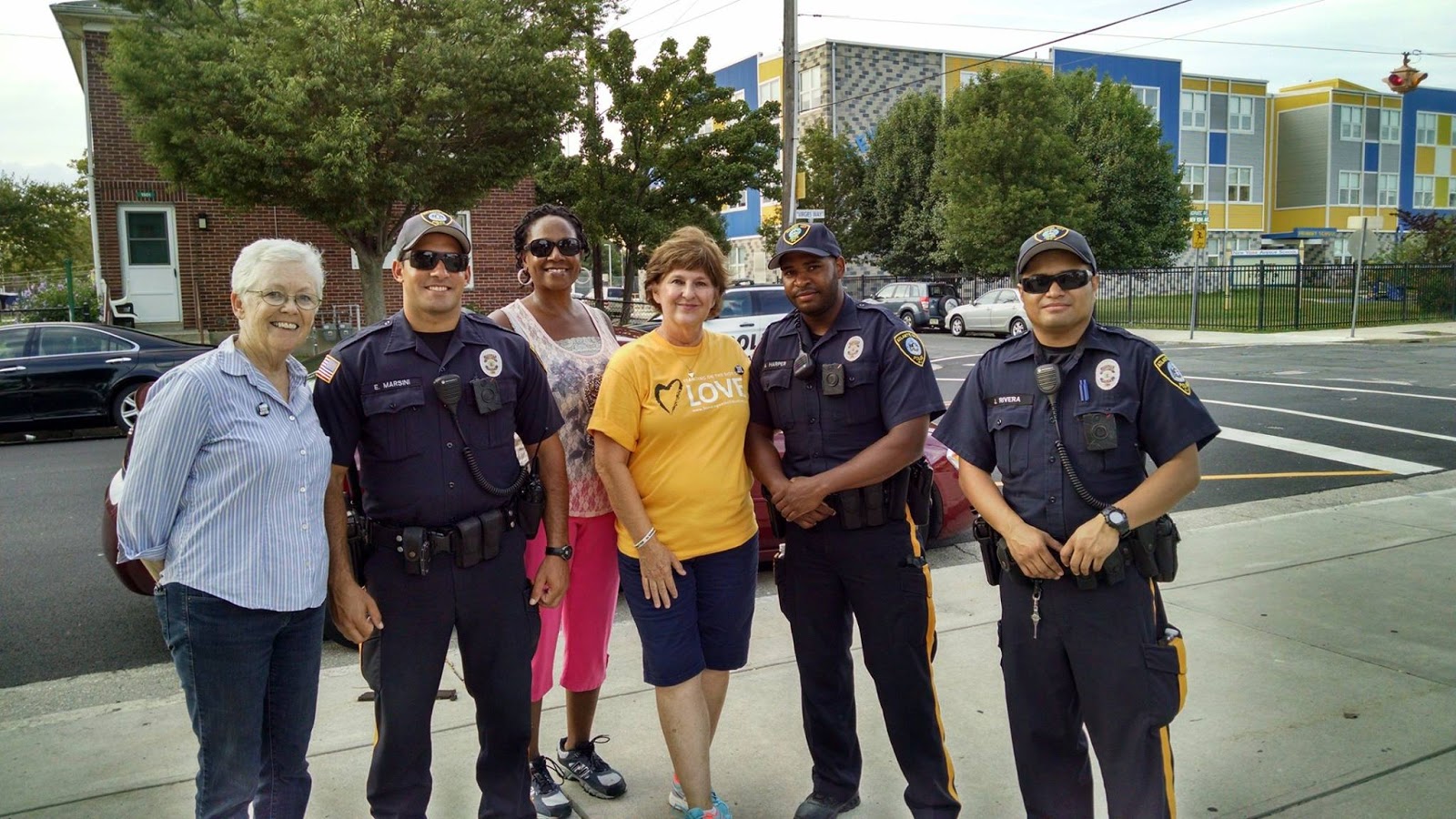
These people were with us because we have been building relationships. We have started to attend walks in Atlantic City organized by the Police Department; we have been helping at a food bank, also in Atlantic City; and we sent flowers to St. Paul AME after the murders in Charleston.


But creating relationships where trust and goodwill are present takes time, effort and wisdom. I feel as if my own preconceptions are being challenged every day. Talking with police officers, especially officers who are persons of color, about their work, the dangers, the decisions they have to make, how they feel about the Black Lives Matter movement, is a bit scary but so important.

Each time I leave Atlantic City, I feel as if I am being born to some entirely new understanding of my life, my world, my childhood, and my past. The words, "Atlantic City" meant nothing to me except "boardwalk," "Miss America," and, later, "casinos." Although I lived a bit over an hour away, I probably went to Atlantic City three times. But I didn't go to the city. It never even crossed my mind that here is a place, a residence, a city inhabited primarily by people of color. 
map showing racial makeup of Jersey shore area, including Atlantic City
Green area is AC (Black residents) Blue =white residents

People who went there to work in hotels, casinos, and in many cases were born there because their parents worked there. There are schools, neighborhoods, gangs, and lots of children. There is hunger, joy, addiction, beauty, love, and renewal. These are my fellow citizens of New Jersey. I love getting to meet them at the food bank, and exhanging a few words. These words, I feel, are like gems. It matters  what I say. Many times, they brighten my day even more than I do theirs. They are survivors. They matter.

You don't have to go far inland to find some of the most virulent hate groups this land has to offer. Right here in South Jersey. Indeed. I was told, the week before we posted the sign, that a "convoy" of these trucks had driven through the towns near our church, including the one we are located in. SPLC (Southern Poverty Law Center) lists 18 hate groups in New Jersey, far more than in Kentucky. I took this picture of two in Manahawkin, near Long Beach Island. What I continue to contemplate every day is the distance I am traversing, short in miles, and yet light years in experience, opportunity, economy, accessibilty, I have taken for granted. This is white privilege. By posting the banner, by wearing the pin, or the wristband, by doing the work of building relationships, I am unlearning white privilege. And there are moments when I simply can not believe it. What it takes to maintain this.


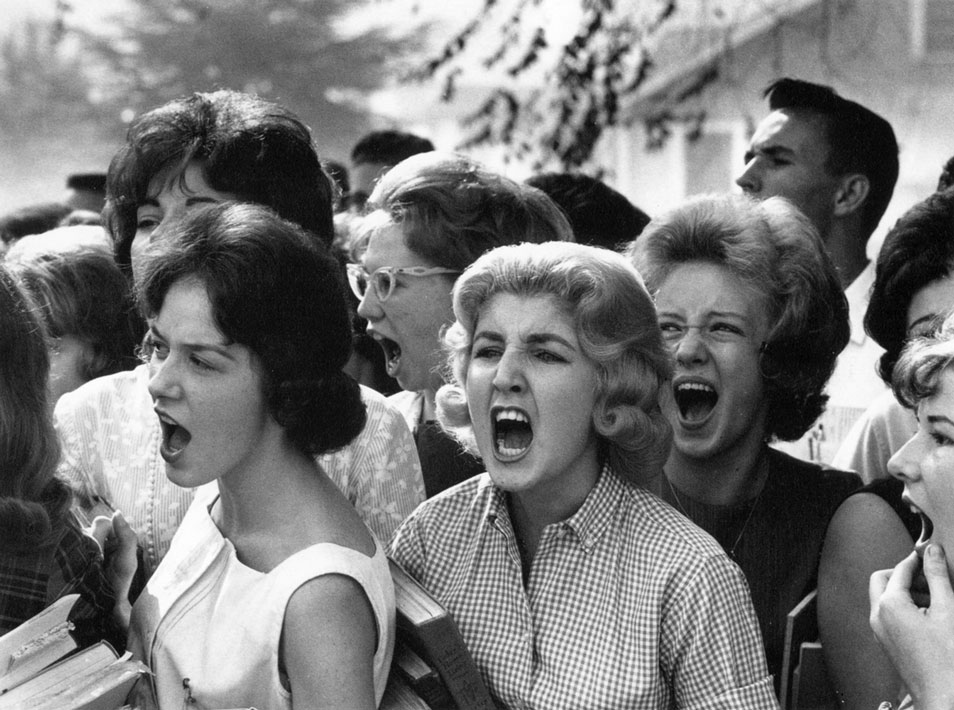
Here's a death threat one of my colleagues recieved on our Facebook page. These people are out there. As soon as the story of our banner and the dedication appeared in the Atlantic City Press, we were bombarded with posts attacking us for the banner. Many of them just said, "All Lives Matter" over and over. But many were far worse, cursing our church, calling us racist, cop-haters, evil, and lots of other things. They've begun to simmer down, but I feel certain that this war of words is going on everywhere, all over the Internet, and that very few people are being convinced either way. I also recognize that many of these people are women. They are angry and vile, and I can't help thinking of the women who stood out in front at the Civil Rights protests, their faces contorted with hate:


After a while, I decided to find out where these people lived. They live all over the country (by the way, almost none in the South, but some in Texas), but only 1 or 2 in New Jersey. This was so helpful. It made me realize that while our immediate neighbors might  be the KKK members or the Confederate flag truck-people, they weren't the ones on Facebook. Maybe they will just chalk our sign up to another thing those liberals are doing, and leave us alone.

But some members of our congregation don't agree. They feel we need to ramp up our security, and that is happening. Three words. Three little words that should be self-evident. I look ahead and wonder, what will our children say about this time? "Why did people attack others for saying 'Black Lives Matter?' " "Was it that bad?"

Well, yes, it is that bad. That's why we have to say it, and go on saying it, despite the threats, the taunts, the vile, ugly attacks. Because the opposite of Black Lives Matter is not "All lives matter." It is "Black lives don't matter." That is being shown to us in countless ways. And attacks on the sign, and on the words, are one more way.


Sunday, August 09, 2015

The Gospel of Thomas (Merton)


Insofar as you did it to the least of one of these my brothers, you did it unto me. Mt. 25:40

Three Greek words: Theodicy; Kairos; and metanoia.

The same day on which we acknowledged the 70th anniversary of the bombing of Hiroshima ( an example of theodicy that is particularly horrendous) having been done by our own country, in our own or our parents’ lifetimes, we also bid farewell to the Jon Stewart show, a kind of news/humor-cast which many progressives freely admit was their only link to sanity for many of these past sixteen years.

As Jon lamented upon hearing of Fox news’ lineup and plans for the “debate” held the same night, things have gotten demonstrably worse!  Did I cause this? “Have my efforts of sixteen years been in vain?”

I, too, as have many of my colleagues, wondered aloud and alone whether our writings, preachings, and marchings and rantings have helped in any way. We don’t doubt that our care and companioning have done some good.
But it is hard, sometimes, to look at the world and ask whether we have progressed, and whether our liberal religious movement has done what it can or should, or done it boldly enough, and yet, we must ask.

I’ve talked about Thomas Merton before. I had a chance, this past month, to attend a discussion group at the Episcopal church in Lexington based upon his late writings on violence, race and Christianity. (Faith and Violence)

This reading, musing, and discussing was intermingled with reading Harper Lee’s Go Set a Watchman, TaNeHisi Coates’ Between the World and Me; Charles Blow’s Fire Shut Up in My Bones; and several other sources about local and regional history of African Americans and the Civil War.

Holy Rosary, the African American Catholic Church in Springfield, KY

The latter were part of a project I’ve begun, something I committed to almost 2 years ago, that has finally come to fruition, a storytelling journey of the Black residents of Springfield, KY, a small city of about 2,500, geographically isolated enough that almost all of the African Americans (22%) are direct descendants of the slaves held by the ancestors of the present day white residents. The town is segregated, albeit de facto, and although it appears bucolic and serene, there is a rage and a fury not far beneath the surface built of decades of injuries. The project will, I hope, grow to incorporate the Sisters of St. Catharine & Loretto, the Wendell Berry Farming Academy, the college, and (eventually) the white citizens, although right now, it’s top secret.I'm not doing this project alone. The only reason I am able to do this is that a woman who is part of the community invited me, and has been a vital component. It is our project, hers as much as mine.

I think many of us, UUs as well as other liberal and progressive people of faith and people of conscience, have watched and witnessed the unfolding of events this past year with a growing conundrum: What can we do? And what should we do?
We may have been rebuffed when we attempt to take part in Black-led movements for justice in the past, or we may have gotten the message that white liberals were no longer welcome with open arms.

Merton addressed this almost 50 years ago, as he wrote about the tumultuous times he was living through, shortly before his untimely death in Bangkok.

The prescience of his writings is almost alarming when we consider the events of the past year, and realize that nearly fifty years have passed since he wrote them.
Most intriguing is the way in which he connected the violence against/by POC with the violence in the world in general.

The Hot Summer of Sixty Seven

"It also seems to me that the gradual, irreversible escalation in Vietnam has a lot to do with the violence at home." Merton, Faith and Violence, 166

"The problem of racial conflict is part and parcel of the whole problem of human violence…. The problem is in ourselves. It’s everybody’s problem."  167

"This is not a campaign for civil rights, it is in effect a kind of declaration of war. The (Negroes) are saying, on various different levels, that white American society is so unjust, so corrupt, so hopeless, so tied up in its own inner contradictions that it deserves to be attacked and even, if possible, destroyed. The end justifies the means… Every form of trickery and violence has been used against them and they intend to return the compliment."  168

"The riots are manifestation of the new interpretation of reality: White society has been judged and found wanting, it has been consistently cruel, hypocritical, unjust, inhuman. The day of retribution has come. …no white man can be trusted…." 170

From Non Violence to Black Power

It is perfectly logical that the America of LBJ should be at once the America of the Vietnam War and the Detroit Riots. It’s the same America, the same slice of Mother’s cherry pie.

(H Rap Brown, Stokely Carmichael: “Black people often question whether or not they are equal to whites because every time they start to do something, white people are around showing them how to do it.” 125'

“The job of the white Christian is then partly a job of diagnosis and criticism, a prophetic task of finding and identifying the injustice which is the cause of all that which keeps war going in order that some might make money out of it.” 129

Discuss:

·      War on Drugs
·      Iraq War
·      Afghanistan


Religion and Race in the United States

The question of Kairos: the time of urgent and providential decision.

"The problem of American racism turned out to be far deeper, far more stubborn, infinitely more complex. It is also part of a much greater problem: one that divides the whole world into what may one day turn into a huge revolutionary interracial war of two camps: the affluent whites and the impoverished non-whites.
What is to be wondered at is not the occasional mass demonstrations and rioting, not the juvenile delinquency, and not the more and more deliberate excursions of small violent groups into other areas of the city to beat up white people and rob them. What is to be wondered at is the persistence of courage, irony, humor, patience and hope in Harlem."

I witnessed each of these qualities as I undertook the work of my project. There was not a person’s home at which I was not greeted warmly, welcomed and invited kindly, offered a comfortable seat and something to drink, even though they didn’t fully understand nor could I explain what my “project” was. The best I could do was tell them that we would at the least get the truth set down somewhere in some kind of way… which is a great deal more than is done now.

grave of LaBryant Poole, a promising and wonderful young man, killed in a car accident at age 15 twenty-seven years ago. His parents divorced soon after. Both are still devastated by his loss.

And I came to see that as a Minister, as a Yankee, a person of means & connections, I did have something to offer them, even if I couldn’t promise anything regarding their challenges or difficulties. My being there and listening, recording their stories for posterity and affirming their value, tells them they matter.  To me at any rate. And curiously, they know they do. It is something they receive from their churches, their faith, and their community, the professions of faith they repeat to one another, over and over, throughout their conversations.

God is good.
I’m allright though.
I’ll make it through.
I can wait on the Lord.
In God’s time.
I’m okay with God.
I ain’t mad.
Ain’t it the truth?

And there was never a time in which laughter was absent, and indeed almost every hour I spent with people who started out as strangers ended with both laughter and tears. And sometimes, even hugs.

Kairos. Urgent and providential decision. Merton, writing about this in 1968 asks:
Has the time passed? “Non-violence is not simply a matter of marching with signs and placards under the eyes of unfriendly policemen…the problem is to eradicate unjustice from white society. Can it be done? How?" 144

Events and Pseudo Events

When I left here in early July, I was still wrestling with questions about how our community and I myself could best respond to the current crises in the country as a UU, and a religious liberal. I felt that we were being called to step up our response to issues of racial injustice, and I also believed strongly that these issues were not divorced from others we are all concerned about: climate change; campaign reform; environmental damage; nuclear power; Middle East peace; wars throughout the world; on and on. Indeed the chilling conclusion of Coates’ book brilliantly ties a rather grim and yet undeniable bow around these intersecting oppressions and exploitations:

the damming of seas for voltage, the extraction of coal, the transmuting of oil into food, have enabled an expansion in plunder with no known precedent. And this has freed the dreamers to plunder not just the bodies of humans but the bodies of earth itself. The earth is not our creation. It has no use for us. And its vengeance is not the fire in the cities but the fire in the sky. Something more fierce than Marcus Garvey is riding on the whirlwind. Something more awful than all our African ancestors is rising with the seas.

And still I urge you to struggle. Coates, 151.

But it was actually during the reading of Coates and Harper Lee that it began to come clear to me that I was not only a minister of a UU congregation, here in a particular place, in a time, with a limited time on earth, but that I had an obligation to figure out what I could do best and be about doing it. That, and a promise I had made, was what gave me the courage to start my project. Kairos.

And metanoia. Which is not merely repentance, or a changing of one's mind.

So when I say “courage to start,” I do not mean that in any way, I was afraid of The African American people of Springfield. I was only afraid of looking or sounding stupid; saying something offensive; fearful because I am painfully shy; and, perhaps worst of all, fearful that my intrusions might imply that that i was promising more of a solution than ultimately the project would bring.

That’s where metanoia comes in. It is often translated as repentance or “change of heart,” but Episcopal priest, writer, and mystic Cynthia Bourgeault calls it a widening of the mind, going beyond the small, narrow,  mind or the duality to the unity. It is really the experience of unity.

Or, as Merton wrote:
“We must continue to treat our (Negro) friends as persons and as friends, not as members of hostile and incomprehensible species, and it is to be hoped they will do us the same honor… (It is) our duty to be authentic Christians to the (Negro) whether he likes us or not…” (170)

I found that when I became clear that what I was doing was not for me but for and with them and maybe, with some luck, it would even help improve things, help other whites change attitudes, and that by not trying we would never know, and that indeed the whole project had a sense of inevitability about it.
But that’s another story for another day.

As Merton Wrote:
If there is a Kairos, and perhaps there still is, it is not a “time” in which once again we will convince the world we are right, but perhaps rather a time when the crisis of man will teach us to see a few sobering truths about our own calling and our own place in the world – a place no longer exalted and mighty, or perhaps even influential.
What if it could be? Amen.