Sunday, July 10, 2016

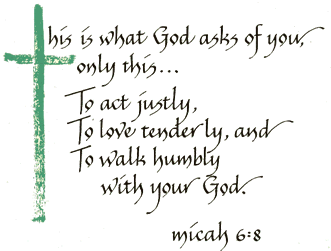
WE CREATED A MICAH


WE MADE US A MICAH

So, the name of the shooter was Micah.

Micah was one of the Hebrew Testament prophets who warned against the greed and avarice of the leaders of the day, and who defended the poor and disenfranchised against the rich and powerful. The book of Micah both laments and prophesies coming doom, as well as predicts an era of peace under the leadership of a monarch in the Davidic line… (which Christians later understood to be Jesus Christ.)

Now, I haven’t heard anyone else make this connection, so I’m sure I’m going out on a theological limb here.

Let’s get one thing straight. I do not believe in a God who would engineer the killing of police officers by the hand of someone with a conveniently Biblical name to make a point. God, for me, is just not that detail-oriented.

However, I’m a Jungian, and I think the synchronicity here, and very possibly the sheer coincidence, is fascinating. And maybe I’m just being an English major/theologian who can’t resist a great extended metaphor.

But, unlike some of my colleagues, who wish they did not have to preach this Sunday, I would love to be with the people of God. Because anti-racism has been my calling since I entered ministry more than twenty years ago, this time in particular has become a time of passionate involvement for me, informed not only by my faith, but by all of my humanity: parent, child, woman, friend, student, writer, wanderer, and preacher.

Micah starts out with a rebuke to those who worship “false gods.” If I were preaching about that today, I’d have a lot to say, but let me start with Chapter 2:

Woe to those who plan iniquity
to those who plot evil on their beds
At morning’s light they carry it out because it is in their power to do it.
…They defraud a man of his home, a fellowman of his inheritance.
Therefore, the Lord says, I am planning disaster against this people
from which you cannot save yourselves.

There is more… lots more. Grab a Bible, and read Micah. It’s short. But essentially (leaving aside the ranting and railing against ‘pagans’) the prophets were full of these exhortations. Micah, in just a few pages, moves rapidly though the threats, channeling God, to the promise (almost identical to that made in Isaiah:

Come. Let us go up to the mountain of the LORD, to the house of the God of Jacob.
He will teach us his ways so that we may walk in his paths…
(People of many nations) will beat their swords into plowshares and their spears into pruning hooks.
Nor will they train for war anymore.

It is quite clear to me that Micah, the prophet, spoke wisdom that applies today. When leaders neglect the poor, the disenfranchised, those who have no voice, no agency, and do so for decades, for centuries, then what we are seeing now is what is wrought.

What surprises me is why this is news.

Why are we shocked?

These extrajudicial killings have gone on and will go on until policing is radically reformed. For me, policing should be abolished, along with prisons, but I realize that is a radical position that will cloud this argument. Having militarized, uniformed, guards patrolling our city streets, stopping and accosting citizens for what has been shown, again and again, to be without cause, and then refusing to use tactics to de-escalate, unless the citizens are white, can no longer be tolerated. African Americans have tolerated and bent to it for decades because they had no choice if they wanted to live.  So, white people who chant “All Lives Matter” and “Blue Lives Matter” and refuse to listen to the cries of injustice no matter who issues them…you expect people of color to what? Be quiet and go back into submissiveness?

That won’t happen. And there is one reason it will not happen.

God is on the side of the oppressed. Christ is on the side of the oppressed.


James Cone, eminent Liberation theologian, writes: “The gospel is found wherever poor people struggle for justice, fighting for their right to life, liberty, and the pursuit of happiness.” (The Cross and the Lynching Tree)
“The Gospel of Liberation is bad news to all oppressors because they have defined their ‘freedom’ in terms of slavery of others.”

And more than that.  Christ is Black. The cross is Blackness. Micah is advocating for people of Color.
James Cone: “The coming of Christ means a denial of what we thought we were. It means destroying the white devil in us. Reconciliation to God means that white people are prepared to deny themselves (whiteness)Take up the cross(blackness) and follow Christ (the Black ghetto.)

I daresay any number of white churches, most if not all, will honor those police officers who died last week. That’s understandable. My question: have they raised up the Black Lives and black bodies in the same way? The sad and ironic thing about the killings wrought by this present day Micah and his prophecy is that of all police departments, Dallas was one that was trying to “reform.” The officers had decided not to wear riot gear, which would have protected them. That’s tragic. Each one killed was not responsible for his death.

But the system is corrupt. Almost everyone understands, but will not acknowledge, the code of secrecy and silence kept by officers. It’s the circling of wagons and the denial and defensiveness against any suggestion of wrong doing that underlies the rage that simply boiled over in someone like Micah. Their tragic and lamentable deaths were wrought by more than that one person.

In Chapter One, besides ‘pagans,’ Micah goes on about ‘prostitutes.’ It’s synchronous again, because I’d not read that when I dreamed last night about police officers. I was in a tower and trying to get out. I kept trying to go up or down winding stairs and saw others going into a room, which I gradually became aware was a place that cops went to meet prostitutes who were kept there. I tried to break through a secret “door” in the wall, but each break uncovered more stone walls. I went into the lobby but saw many cops lounging around, all in street clothes. Of course, since I am Jungian, I have to understand this dream as one that is more about myself than about the police.  I have to ask where I am policing myself, why am I trapped in this tower, what is being prostituted and why? Details to follow. But today I can’t help touching upon the surface, more literal meaning, not that I think cops are holding prostitutes in towers, (although I was told the frequenting of them and silencing around it is routine and well known in Atlantic City) but that I see actual police as somehow selling out or keeping me from being free. Is there something about this race/police issue that I can’t break through to? That I am trapped/imprisoned about? It was clear to me that I would not be kept amongst the prostitutes. I was too old. And yet… I couldn’t escape. There was no way out.

And, this: Micah was trained by our military. We made him a sniper. We, who have allowed, since 9/11, endless wars and militarization, and horrible (I have experienced this first hand with Veterans in my congregations) after care and mental illness care for Vets, and with the militarization of police departments in turn, a Micah to even be out there. No place to turn with his rage.  No real help for his deep, deep distress. He, too, is a victim. And killed, by a militarized, robotic, bomb. I will not name him a monster.

As James Cone said, The truth about injustice always sounds outrageous.

Finally, I turned, this weekend, to another James: James Baldwin. “Jimmy,” as he was known to his many friends and colleagues, wrote so eloquently and poignantly of the state of being black in America, a state he could see with eyes that pierced through the illusions we mostly live by. He suffered for the truths he told, and ultimately left this country. He went to a beautiful, country estate in France, not far from Nice, where he could be what he could never be in America, a free, Black man.

I’ll let his words be the benediction:
In the private chambers of the soul, the guilty party is identified, and the accusing finger there is not legend, but consequence, not fantasy, but the truth. People pay for what they do, and still more, for what they have allowed themselves to become. And they pay for it simply: by the lives they lead.


What life will you lead? In the final analysis, you may have more freedom than you imagine.

Amen.


Sunday, January 24, 2016

On Self-Doubt, and the White Saviour Phenomenon: Reflections at MLK Week.


Our son Seth at Disneyland, 2012


When I am in Kentucky, I am working on a project to gather and make public the stories of the people of color in a small town. In order to do this, I'm working hand-in-hand with a woman who grew up in the African American community, and who is deeply entwined in their history. She asked me to work with her. In my mind, and in my heart, I know that I am using the skills I have gleaned as a minister, as a writer, and as a spiritual director, to be present with people, to draw out and treasure their tales, and to bring them cohesively into what I pray will be a narrative that is both an agent of change and an agent of healing for a still-marginalized and very much oppressed minority.

This is in addition to the work that the interim congregation I am serving in New Jersey has done by posting a Black Lives Matter sign, and starting a partnership/lecture series with a Black United Methodist congregation in Atlantic City. So, many of my waking hours are devoted to the issues of Black Lives, which have become, in my eyes, the issues of the day.


Residents of Atlantic City & Atlantic County share stories on Black Lives
Why did I put the white guy in the center!? 


But I perpetually question my own motives. What part of this is about me, and my need to feel useful, to feel that somehow I am doing something to stand against the forces of racism and discrimination that still exist across this land? Worst of all, do I fall into the category of the "white Saviour?"

During the week before the MLK holiday, I was at home in Kentucky, and when there, I often attend the town's AME Zion chapel. The pastor, a woman, has agreed to collaborate in the project, as well as to allow the photographer I've asked to potentially work with us to take some photos during a service. I have felt both blessed and somewhat surprised at their welcome for me. Let's just say that were I a person of color in a small town that felt as if it were about 1975 today, I'd question the motives of a white woman coming in from outside to "write a book or a documentary.." Enough said.

"Oh, NO! I am centering myself. " (White savior anxiety)

Last time I went there, I spoke with a woman from the community I'd known for a few years, and met her son, who is 11. On the way to school the next day, I mentioned to Seth, who, because of his Autism, doesn't get a lot of play dates, that maybe the two could play together sometime. At first he thought I was talking about the congregation I am serving in New Jersey. No, I said, the African American church we went to. To which he responded: I thought Martin Luther King fixed that a long time ago. I stammered something, and he added: What? Did the white people forget?

Indeed the correct answer here is "Yes. The white people did forget." And that includes those of us, liberals and progressives, who, whether because of our preoccupation with other matters or, and I will freely admit that I fall into this category, because of our fear of being looked upon with mistrust and even scorn, of being seen as or even actually being  that "white savior"  mentioned in articles like this one from Huffington Post  or this one, from the Atlantic, just quietly stepped away from working on matters of racism.
Second attack on sign. Since this one, it was painted over again.


The reality is that some of us dedicated our ministry to anti-racism decades ago. We are not looking to be "saviors" or to win awards. We are compelled to join the struggle because to do otherwise would be to live a life of such compromise that we would feel, especially now, that a new Civil Rights movement has begun in full bloom, utterly hypocritical.

Unified Black Students of Stockton Rally November 2015.

James W. Perkinson, in White Theology: Outing Supremacy in Modernity, argues persuasively and eloquently that white solidarity must be born of not only conviction but of pedagogy and struggle. He also states that white solidarity, to be genuine, must be embodied in what he calls "the sacrament of a post white vocation.." a kind of Baptism. For white people, the functional equivalent of such a "baptismal" reprogramming is a life-long self-discipline and self-confrontation in the existential schools of racial encounter, inculcating a different habit of perception, able to see and feel the significance of the entire system of supremacy that bears down with such intransigent weight...Before there can be cognition of a new possibility, there is need for a newly felt consternation inside "the problem." The problem is a code of absolute differentiation habituated deep inside the white body that requires sustained confrontation and interior work.  (Perkinson, 245)

So, while I have to check in with my colleagues who are also active in this movement, while I need to examine my own motives and my own actions, I also need to trust my heart, stay true to my convictions. I need to listen to and read the voices that affirm my passion. In fact, I should have done that long ago.
My great grandmother, Mora Lake Patton. Cherokee Indian. I think of her sometimes. She died in childbirth.

Tuesday, December 01, 2015

Terrorisms We All Face and the the Privilege we Take for Granted


My great-grandfather & three daughters, after the death in childbirth of his wife & son

I have tried to imagine the pain and daily stress of living as a person of color in this country. I do so not to suggest that I, a white, educated, middle to upper middle class heterosexual woman, really can identify with that pain, but because I want to understand as deeply as I can, if even infinitesimally, what it is like to be marginalized, and then to say to myself: Multiply this by the thousands. Now you have the experience of a person of color. Multiply this by a lifetime.

I don’t know whether it is helpful/right/or wrong for me to think about this. I only know that it has given me a window into my own experiences and how they affected me, how I did/did not handle them, how they have continued to play a part in my worldview.

My mother, Marjorie P. Cain 1916-1960


I would say that my first experience of being marginalized was having a mother who died suddenly when I was five. In our small, rural school, this was something that did not happen. Rather than being embraced in some way by the community, our family (which by virtue of my father’s isolation and refusal to discuss her death) was undoubtedly the subject of gossip and whispers. I can recall a schoolmate saying, “My mom said your mother died because she was crazy.” Because we were forbidden to talk about her, I had no place to take this. My response to the unnamed grief and felt judgment and fear of my peers (I see now) was to “feel sick” and go, almost daily, to the school nurse with vague symptoms until my father hauled me off to the doctor so that he could pronounce that there was Nothing Wrong with me so I would stop faking it.
As a young girl, with step brothers.


Later, I was teased for things like having a slight  lisp, walking with my feet turned out, but these seem minor. I suspect nearly everyone is ostracized in this way. The pointing out of these “flaws” actually motivated me to work on them until they were (almost) unnoticeable. If anything, I became more of an insider, part of the group that marginalized the “other” during most of the rest of my school years. I wouldn’t say I was a “Mean Girl,” but I sure didn’t step up and speak out when others were being shunned or treated hurtfully.

Teenage me, insecure.


In my first marriage, I accepted the role of a stay-at-home wife and mom. Although I had a degree, and a strong will, I sat through jokes, comments, and slights made by men who, gathered together and consuming alcohol, were supposed to be “funny” but were demeaning to women in general, and to those present in particular. I stayed quiet while my husband openly “checked out” and flirted with other women. I worked in restaurants where women were treated like objects to be groped in the kitchen by cooks and even managers. It barely crossed my mind that any of these things were other than typical male behavior that had to be endured.
The church, an attraction for terrorists.


Now, having been a minister for twenty years, I have witnessed and listened to tales of members of congregations treating ministers horribly. These people have been willing to use tactics that are so similar to those of terrorists that it is alarming. Indeed, I am not the first person to use the phrase “terrorists in the church.” Vague and indirect threats, surveillance, manipulation, secret meetings, misinformation, and much more have led to ministers’ resignations, terminations, upheaval in congregations, lack of trust in our community, dire financial and professional consequences, and yes.. I would argue, suicide and early death. Because ministers care about the other people in the congregation, as well as their own future, they often leave without pointing fingers, and the terrorism continues. This occurs across denominations. So, yes, there have been times when, as a clergy person, I have felt like a marginalized person, a person with no power, no agency, unable to express the truth or to be believed.


Nonetheless, I grew up and understood the issues surrounding my mother's untimely death and gleaned ways to cope. I was able to leave the marriage in which I felt demeaned and diminished, although I know that many women still bear this fate. And, although I faced the terrorism of antagonists in the church on numerous occasions, I gleaned tools to endure them, and I knew that ultimately I could leave ministry if I must.

It was not until, after adopting our son Seth, an autistic child who is now ten, that I experienced a fraction of what a person of color might. Because his disability is visible to others, because it is something he will always live with, and because there are so many stereotypes and misconceptions about Autism and ASD (Autism Spectrum Disorders) I have experienced, and witnessed him experience, judgment, cruelty, shunning, inequity, dismissal, and assumptions of every stripe from strangers and church members and even "family." It was in this arena that I finally glimpsed, perhaps, an iota of what a person of color must feel. Anger, rage, indignation, and even fury at the insensitivity and downright cruelty of human beings. And yet, I have also realized that I have been less compassionate than I ought to have been before Seth became a part of my life. Besides being a treasure, he has taught me innumerable lessons.
Seth & his teacher 2015


Now. All of this aside, I walk into the world each day with a freedom, a passport, a red carpet, and open doors.. all because of one thing. The color of my skin. But from this time on, I do not take that for granted.

For every privilege I accept, for everything that I have been given for free, including the benefit of the doubt, I will stand up for, fight for, argue for, the rights and freedoms of a person of color. It’s the least I can do.